
Bat Removal
🚨 24/7 Rapid Emergency Wildlife Removal • Rockford, IL
Bat Removal & Exclusion in Rockford, IL
Bat colonies in attics and wall voids require specialized, humane one-way exclusion devices and professional guano cleanup. Protect your home and restore air quality safely.
- ⚡ Same-Day Emergency Response in Rockford & Winnebago County
- 🛡️ 100% Humane Removal & Permanent Entry-Point Exclusion Guarantee
- ⭐ Licensed, Insured & Local Illinois Wildlife Control Specialists
Bats in Rockford Buildings
The Big Brown Bat is the most common species found roosting in buildings across Illinois. Little Brown Bats are also present. Both are colonial animals — where you find one, you’ll find more. A single colony in an attic can number from a few dozen to several hundred individuals depending on how long they’ve been roosting there undisturbed.
Bats can enter through openings as small as 3/4 of an inch — a gap that most people wouldn’t notice on a casual inspection. Common entry points include gaps along the roof ridge, openings at the soffit-fascia junction, spaces where siding meets the roofline, and any deteriorated flashing or trim. Bats do not gnaw or create entry points — they use existing gaps.
Bat colonies follow a predictable annual cycle. In Illinois, bats typically arrive at roost sites in spring, raise their young through summer, and either migrate or move to hibernation sites in fall. The summer period — roughly May through August — is a maternity season when young bats (pups) are present and cannot yet fly. This period requires careful exclusion planning.
Signs of Bats in the Attic or Building
- Guano (droppings) accumulating at the base of the building, on window ledges, or below the roofline
- Bat guano is small, elongated, coffee-bean shaped — and crumbles to a fine powder when dry
- Strong ammonia odor from attic spaces with established colonies
- Bats seen flying out from the building at dusk — typically in a visible stream from one or two exit points
- Chittering or rustling sounds from the attic or walls, especially during warmer months
- Finding a bat inside the living space (usually a young bat that has lost its way)
- Staining on exterior walls near the roofline — from the oils in bat fur on entry/exit points
Property and Health Considerations
Bat guano accumulates over time in attic spaces. A long-established colony can produce significant quantities of guano that soaks into insulation and structural materials, creates a powerful odor, and in some conditions can support fungal growth. Guano cleanup after bat exclusion is recommended when accumulation is substantial.
Bats are wildlife, and bat bites are a public health consideration when direct human contact occurs. If a bat is found inside the living area and there is any possibility of contact with a sleeping person or child, contact your county health department for guidance. This is a precautionary issue, not a reason to panic — but it should be taken seriously.
Bats are also ecologically valuable. They consume enormous quantities of insects — a single bat eats thousands of insects per night. This is part of why killing bats is both illegal and counterproductive. Exclusion is the legal and effective approach.
Why Bat Exclusion Is Different From Other Wildlife Removal
- Bats are federally and state protected — killing them is illegal
- Exclusion during maternity season (May–August in Illinois) requires special handling to avoid trapping young inside
- All entry points must be identified and sealed — bats will find any remaining gap
- One-way exclusion devices must be positioned correctly at all confirmed exit points
- Full exclusion requires leaving devices in place for several days to ensure all bats have exited
- Final sealing of all gaps uses materials bats cannot access — caulk, foam, mesh, and flashing
- Guano cleanup is a separate process from exclusion itself
The Bat Exclusion Process
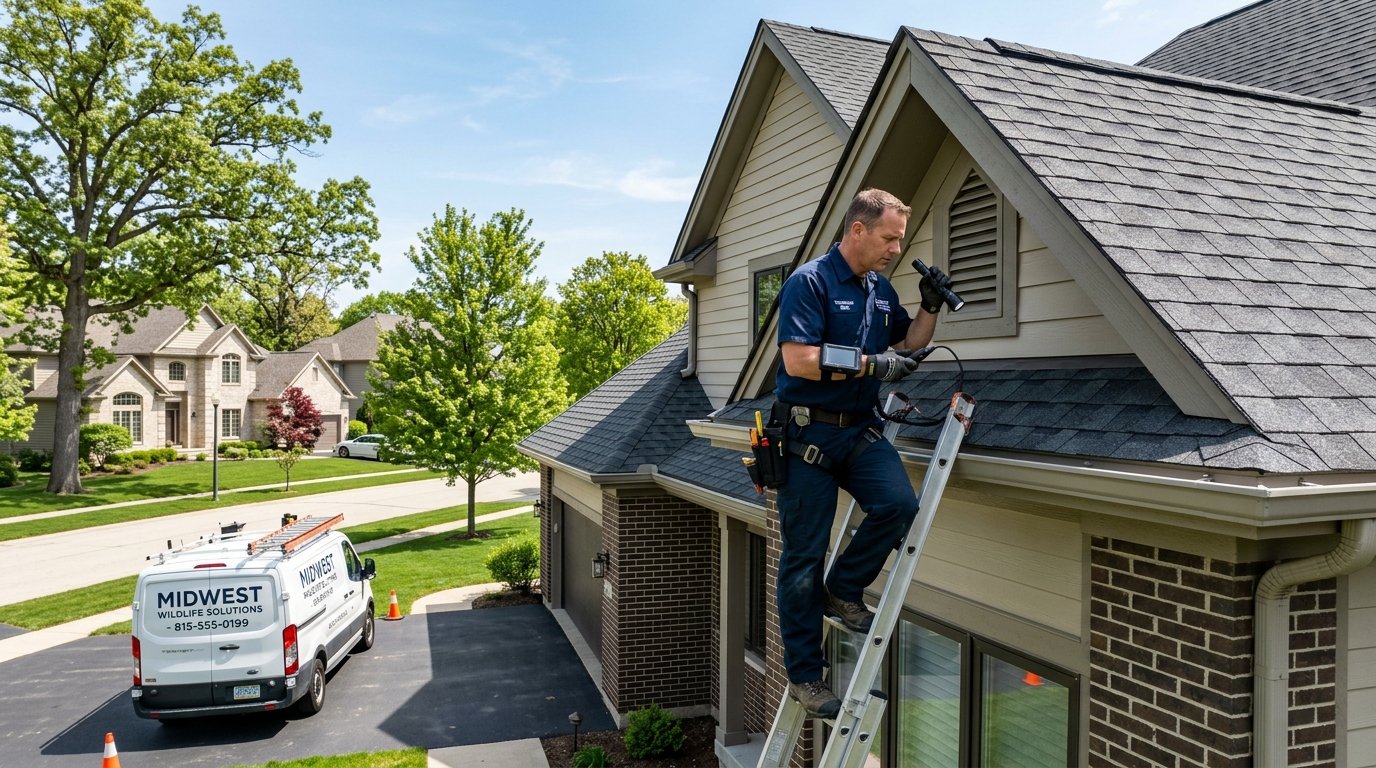
Bat exclusion begins with a thorough exterior inspection to identify every opening that bats could be using. This typically requires a close inspection of the roofline, fascia, soffit, chimney flashing, and any construction gaps.
One-way exclusion devices — typically a mesh tube or netting — are installed at the confirmed exit points. These allow bats to leave naturally when they go out to forage at dusk, but prevent them from returning through the same opening. Secondary gaps are sealed completely during this phase.
After enough time has passed to ensure all bats have exited (typically several consecutive evenings of monitoring), the one-way devices are removed and the final gaps are permanently sealed. The exclusion is then complete.
Season matters. During maternity season, the exclusion approach must account for the presence of pups that cannot yet fly. Excluding bats during this period without accounting for pups results in them dying inside the structure — which creates odor and pest problems and also defeats the purpose. Contact us for guidance specific to your timing.
📍 Serving Rockford, Illinois — Contact us for help with wildlife on your property.
Bat Removal FAQ
I found a bat inside my house. What should I do?
Open a window or exterior door and give the bat a way out. Do not try to catch it with your hands. If the bat cannot find its way out, you can use a box or container to gently trap it against a wall and slide cardboard underneath to contain it, then release it outside. If anyone in the home was asleep when the bat was found — especially a child — contact your county health department for guidance on exposure precautions.
Can I seal the bat entry points myself?
You can seal secondary gaps yourself, but the primary exit points should have one-way devices installed before final sealing. Sealing an exit point with bats still inside traps them — they may find their way into the living space, and eventually create a serious odor problem. Professional exclusion ensures the animals are outside before sealing is completed.
What time of year is best for bat exclusion?
In Illinois, the safest window for bat exclusion is roughly August 15 to October, or March to April (before maternity season begins). Exclusion during maternity season (May through mid-August) requires more careful handling to avoid trapping pups. Contact us to discuss the best timing for your situation.
How do bats get into the attic if there are no visible holes?
Bats can enter through openings as small as 3/4 of an inch — gaps that are easily missed. Common locations are along the ridge cap, where soffit panels meet the fascia, at the edges of chimney flashing, where pipes or wires enter the structure, and at any deteriorated wood or trim. A professional inspection is the only reliable way to find all the entry points.
Related Services
Bats in Your Attic or Home?
Bat exclusion requires the right timing and approach. Call to discuss your situation.